Origins
Behind the mask at Venice’s Ridotto
A state-run gaming room, a Carnival costume and two Guardi paintings reveal a Venetian institution shaped by social distinctions as much as disguise.
1638: a public room within Carnival
Venice’s civic museums date the opening of the public Ridotto to 1638. That date gives this history a firm starting point, but it does not explain the institution by itself. The important details are its setting at Palazzo Dandolo near San Moisè, its operation by the Venetian state and its connection with the Carnival season. The museum’s account of Guardi’s painting places the usual season between 26 December and Ash Wednesday.
For a reader familiar with today’s casinos, the seasonal setting is worth pausing over. The Ridotto belonged to the city’s calendar of licensed sociability. Reading it only as an early version of a modern gaming floor would strip away the customs that made this particular room intelligible.
Sources: MUVE: Biribissi programme (2018); MUVE: Il Ridotto.
The bauta was more than a face covering
The word bauta can refer to a wider costume as well as the mask. MUVE’s entry for an eighteenth-century bronze mask form at Carlo Goldoni’s House distinguishes these meanings and describes an ensemble involving a mantle and a tricorn hat. It also explains the mask’s projecting lower shape and its effect on the wearer’s voice.
The surviving form brings a material object into a story often told through elegant crowds. It points towards making, fitting and wearing a disguise. MUVE also connects masked encounters with a convention of courtesy towards an unidentified person. Our reading is that concealment could itself acquire a recognisable social form: the identity might be obscured while the costume remained highly legible. That is different from saying nobody could ever recognise the wearer.
Sources: MUVE: Bauta mask form.
Who remained unmasked?
The Ridotto’s rules did not make every person look the same. According to MUVE, an exception to the mask requirement applied to the nobles who kept the gaming banks. These men, drawn from less wealthy patrician families, were known as Barnabotti.
That exception changes how the masked room should be imagined. A hidden face was not evidence that rank, money or authority had vanished. There were different roles within the institution, and its dress convention distinguished those roles. The contrast invites a more precise historical question than whether Carnival made everyone equal: who was permitted to conceal an identity, who remained identifiable, and what position did each occupy around the game?
Sources: MUVE: Il Ridotto.
The casino story continues outside the door
A document reproduced by the State Archive of Venice shifts attention from the gaming room to the journey home. Its 2012 exhibition catalogue includes Giovanni Grevembroch’s eighteenth-century account of lantern-bearing escorts. The entry describes them accompanying masked people between the theatre, the Ridotto and home, particularly during Carnival.
This small piece of evidence puts work back into the scene. An evening of masked leisure depended on people providing an ordinary service. It also places the Ridotto within a route through the city rather than isolating it as a self-contained attraction. The passage cannot tell us how every visitor travelled. It does, however, preserve an occupation that disappears when casino history is reduced to famous guests and expensive clothes.
Sources: Venice State Archive catalogue (2012).
Two Guardi paintings, two different records
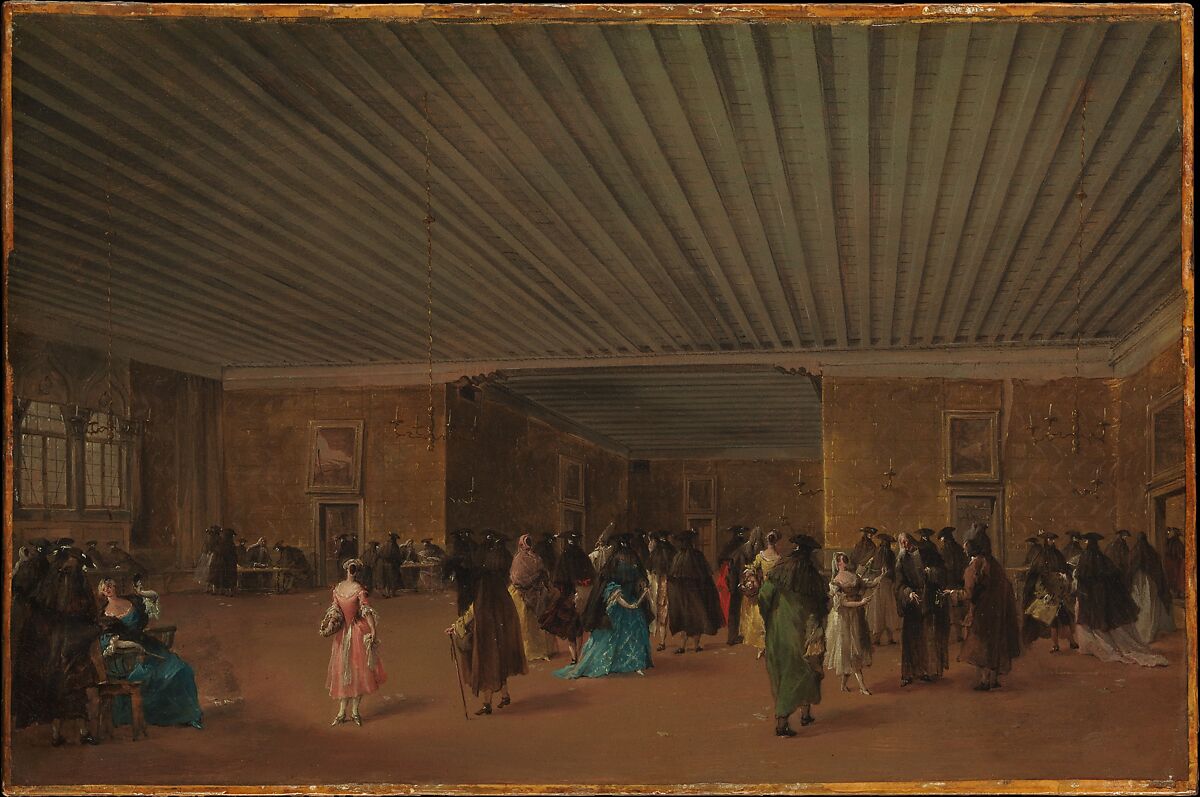
The name Guardi can cause confusion because more than one surviving picture depicts the Ridotto. MUVE dates its large canvas at Ca’ Rezzonico to 1746–1750. The Met’s much smaller interior is dated approximately 1765–1768. These are different objects, not competing dates for the same painting.
The Met places its scene before a remodelling in 1768 and draws attention to worn furnishings and the room’s theatrical character. That reading complicates an image of uninterrupted splendour. A painting can register a room’s condition as well as its fashionable company. Keeping the collection, date and object identity attached to each image prevents a later view from being casually presented as a record of the opening in 1638.
Sources: MUVE: Il Ridotto; The Met: Guardi’s Ridotto.
| Collection | Museum’s dating | Object identification |
|---|---|---|
| Ca’ Rezzonico, Venice | 1746–1750 | Francesco Guardi, Il Ridotto; inventory Cl. I, n. 124 |
| The Metropolitan Museum of Art | Circa 1765–1768 | Francesco Guardi, The Ridotto Pubblico at Palazzo Dandolo; object 1997.117.5 |
What a painted crowd can—and cannot—establish
In the Met image reproduced here, the ceiling occupies a large part of the composition. Its parallel beams lead towards the rear wall, while the figures form a much lower band across the room. Dark clothes are interrupted by pink and blue garments. Several groups seem absorbed in their own exchanges rather than directed towards a single central spectacle. These are observations of the digital reproduction, not an identification of individual visitors.
A painter chooses which area of a room to show, how figures relate and where attention goes. The image can make social encounters visible without supplying a complete account of an evening’s play. A painted gesture is not a transcript of a conversation; a group of figures is not an attendance register.
We use these pictures as evidence of how the Ridotto was represented, with the museum records supplying identification and historical context. They cannot establish admission costs, typical losses or the wealth of particular visitors. Those questions require different records. This distinction lets the painting remain useful without asking it to answer questions beyond its evidence.
Sources: The Met: Guardi’s Ridotto; MUVE: Il Ridotto.
1774 is a closure date, not an explanation of everything
MUVE records that the public Ridotto closed in 1774 for reasons of public order. This is an important boundary for its institutional history. It does not establish that every form of Venetian gambling or masked sociability ended at the same moment.
The name also needs care. The State Archive’s catalogue includes notices for a Ridotto at La Fenice in 1819, concerning masked dances. That later use belongs to a different venue and activity. It is not evidence that Palazzo Dandolo’s public gaming house continued unchanged. When tracing an old casino name, the building, the organisation and the kind of gathering must stay attached to it. Otherwise a familiar word can create a false continuity across several decades.
Sources: MUVE: Il Ridotto; Venice State Archive catalogue (2012).
Recreating play is another layer of history
The museum’s 2018 Biribissi event shows how the Ridotto is interpreted today. Palazzo Mocenigo hosted a theatrical programme in which a performer playing a Venetian nobleman recounted changing fortunes around a gaming table. The programme described Biribissi as a popular historical game. This was a modern museum presentation, not a surviving eyewitness report or a current event listing.
Keeping those categories separate makes the history richer. A costume form offers material evidence; an archive catalogue points towards documents; Guardi’s canvases offer composed views of sociability; a performance gives a contemporary interpretation. None has to stand in for all the others. Together they allow the Ridotto to emerge as a particular Venetian institution, shaped by dress, public authority, paid work and the seasonal rhythms of the city.
Sources: MUVE: Biribissi programme (2018); MUVE: Bauta mask form; Venice State Archive catalogue (2012); MUVE: Il Ridotto; The Met: Guardi’s Ridotto.