Facts checked Article
Casino history & culture
The 1960 gaming settlement tried to keep commerce away from the table
Read the gap between Parliament’s expectations for gaming clubs and its later diagnosis of commercial casinos through three debates and the 1968 Act.
A permission to play was not an invitation to open a casino
The Betting and Gaming Act 1960 belongs in the history of British casinos, but describing it simply as the moment casinos became legal hides the argument that made it possible. At the Bill’s Third Reading on 11 May 1960, minister Dennis Vosper said the government opposed the establishment of casinos.
He nevertheless defended changes intended to give people greater freedom to bet and play games for money. Those positions were compatible within the settlement he described: permission for play, coupled with restrictions on commercial exploitation.
This article reads that distinction through three parliamentary debates and the Gaming Act 1968 as enacted. It follows one question: how could a reform presented as a barrier to commercial casinos become something a later Home Secretary blamed for their expansion? The answer is in the relationship between the game, the organiser and the club.
The sources do not give us a complete census of rooms or a reliable opening date for every famous venue. They give us something different: contemporary statements of intention and criticism, followed by the machinery of a replacement statute. Speeches are evidence of what their speakers argued.
They are not neutral measurements of everything happening outside Parliament.
Sources: Betting and Gaming Bill, 11 May 1960; Gaming Bill, 13 February 1968; Gaming Act 1968 as enacted.
Four records: what each one shows
- 11 May 1960, Commons Third Reading
- Minister Dennis Vosper said the government opposed the establishment of casinos, while defending changes intended to give people greater freedom to bet and play games for money.Betting and Gaming Bill, 11 May 1960 · as checked on
- 19 May 1966, Lords debate
- The government's account described two safeguards, equal chances and restrictions on the charge for participating, and referred to section 32 of the consolidating 1963 Act.Gambling, 19 May 1966 · as checked on
- 13 February 1968, Gaming Bill
- James Callaghan argued that concessions intended for genuine members' clubs had been usable by commercial enterprises, and criticised the absence of a ceiling on club charges.Gaming Bill, 13 February 1968 · as checked on
- Gaming Act 1968, section 10
- The enacted text established the Gaming Board for Great Britain and specified its review function over the extent, character and location of gaming facilities.Gaming Act 1968 as enacted · as checked on
Dated record entries, each read against the document it comes from. Speeches are evidence of what their speakers argued, not a census of rooms.
Three safeguards, and the exception that mattered
Vosper’s account separated the chances within a game from the money earned by its organiser. He described a scheme in which players should have equal chances, promoters should take no cut from stakes, and admission charges should generally be prohibited except for clubs. The exception made the club more than a social label.
It became part of the financial arrangement being debated.
Imagine an undated membership leaflet in an archive. It promises a room, refreshments and games. The word “club” on its cover cannot tell the historian whether the organiser benefited from the stakes, charged for admission or collected a recurring payment while play continued.
Those are different questions, and the leaflet may answer none of them.
An archive note can therefore begin with three columns: who plays, who receives money, and what the payment buys. This is an original reading method, not a reconstruction of a particular prosecution. It prevents the familiar picture of a velvet room from doing the work of a financial record.
It also explains why a room’s name is weak evidence for the legal basis on which it operated.
Sources: Betting and Gaming Bill, 11 May 1960.
1960: the three safeguards Vosper described
The scheme as the minister set it out at Third Reading. The third item carries the exception that made the club part of the financial arrangement.
Ticks are kept only in this browser and are never sent anywhere.
By 1966 the club charge was part of the problem
In the Lords debate of 19 May 1966, the government’s account described two safeguards: equal chances, including the banker where relevant, and restrictions on the charge made for participating. The speech referred to section 32 of the consolidating 1963 Act.
That detail matters when following the paper trail: a debate about the consequences of the 1960 reform need not cite a section numbered in the 1960 statute.
The speaker described a system intended to allow a charge before play rather than repeated extraction from stakes. The same debate discussed the commercial exploitation of casino games. We should keep that ministerial explanation attached to its date and speaker, rather than rewrite it as a timeless definition of a casino.
For a researcher, the change in statute number is a warning against searching only one Act. An old press cutting might describe an offence under later consolidated legislation while discussing a business that opened after the earlier reform. The date of the room, the date of the governing text and the date of the debate are separate entries.
Keeping them separate makes the history more intelligible without claiming that every ambiguity was already resolved in court.
Sources: Gambling, 19 May 1966.
Callaghan’s diagnosis was about the organiser
Introducing the Gaming Bill on 13 February 1968, James Callaghan criticised the earlier settlement in direct terms. He argued that concessions intended for genuine members’ clubs had been usable by commercial enterprises without an adequate system of verification. He also criticised the absence of a ceiling on club charges.
This was a minister explaining why Parliament should accept a new Bill.
His diagnosis helps connect two apparently inconsistent historical statements: the earlier government said it did not want commercial casinos; a later government said the legislation had helped produce them. The missing link was the organisation charging for gaming. A rule about equality between players did not, on its own, answer how a separate business earned its income.
That is the analytical distinction to carry into a venue history. Evidence that a game offered equal chances would not establish that access to it was non-commercial. Conversely, evidence of an expensive membership would not by itself establish that every game was unlawful.
Neither conclusion follows from the other. The surviving documents must be read for the particular relationship they establish, rather than enlisted to prove a whole room innocent or notorious.
Sources: Gaming Bill, 13 February 1968.
Terms used in the record
- Third Reading
- The final Commons stage of a Bill before it passes to the other House; the minister's speech there states the government's case.
- Consolidating Act
- A statute that gathers earlier provisions into one text, so a later debate may cite a section number the original Act never had.
- Banker
- The participant who takes the other players' bets in some games; the 1966 account said equal chances should include the banker where relevant.
- Members' club
- A club run for its members rather than as a business; the concession for club charges was intended for genuine ones.
- Gaming Board for Great Britain
- The institution the 1968 Act created to keep gaming under review, including facilities on licensed or registered premises.
- Royal Assent
- The moment a Bill becomes an Act; it does not mean every provision took practical effect that day.
A four-record comparison
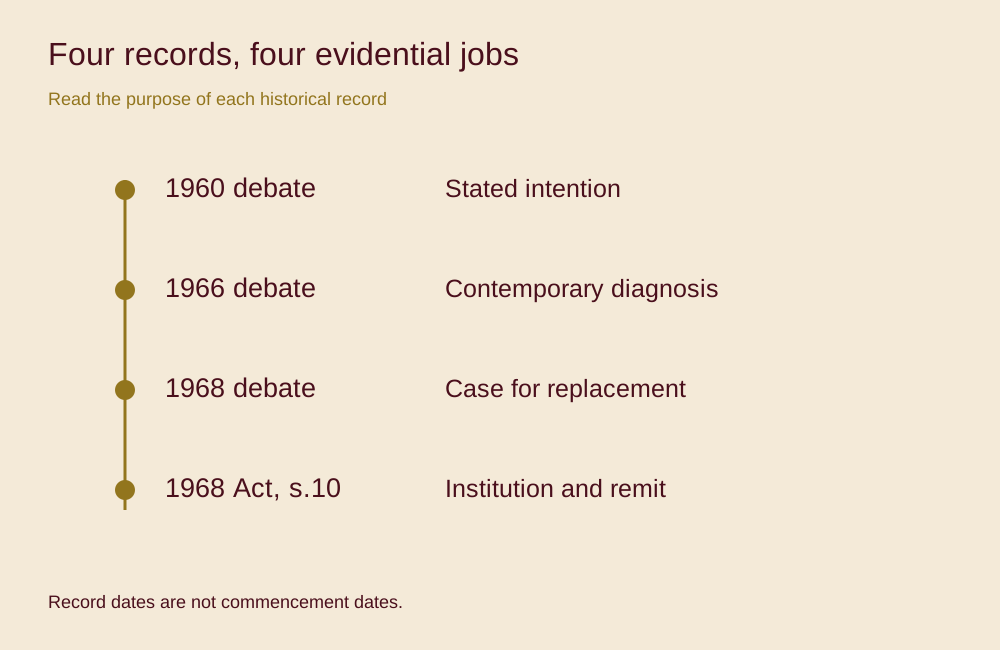
The comparison below separates a proposal’s intention from a later criticism and from enacted institutional powers. Dates identify the records; they are not asserted commencement dates.
11 May 1960, Commons Third Reading: the stated policy allowed greater freedom to gamble while attempting to restrain commercial exploitation. Use the record to establish what Vosper defended, not the profitability of a named club.
19 May 1966, Lords gambling debate: the government explained the intended safeguards and discussed the emerging casino problem. Use it as a contemporary diagnosis, not a verified count of all operating venues.
13 February 1968, Commons Gaming Bill debate: Callaghan identified weaknesses in the treatment of clubs and charges. Use it to explain the case for replacement legislation, not to attribute every later closure to one cause.
Gaming Act 1968, section 10: the enacted text established the Gaming Board for Great Britain and specified its review function. Use it to identify an institution and its statutory remit, not to assume that every provision took practical effect on Royal Assent.
These four rows form the article’s source-to-claim comparison. A timeline that collapses them into “casinos legalised, then regulated” loses the dispute over what the first permission was supposed to permit.
| Record | Evidential job | Does not establish |
|---|---|---|
| 11 May 1960 debate | Government’s stated intention | A named club’s profitability |
| 19 May 1966 debate | Contemporary diagnosis | A verified venue census |
| 13 February 1968 debate | Case for replacement | Every closure’s cause |
| 1968 Act, section 10 | Institution and remit | Every commencement date |
Sources: Betting and Gaming Bill, 11 May 1960; Gambling, 19 May 1966; Gaming Bill, 13 February 1968; Gaming Act 1968 as enacted.
The 1968 Act made premises and supervision explicit
Section 10 of the Gaming Act 1968 established the Gaming Board for Great Britain. Its duties included keeping under review the extent and character of gaming, with specific attention to the extent, character and location of facilities on licensed or registered premises and those covered by applications. Section 11 referred the licensing and registration machinery to Schedule 2.
The structure of the Act also separated gaming on premises licensed or registered under Part II from the arrangements addressed in Part I. That architecture is more revealing than treating the later Act as a simple switch from prohibition to permission. The historian can see distinct categories of premises and an institution charged with observing the field.
This does not mean the Act supplies a ready-made account of a particular evening in a casino. For that, the next records would be a licence, an application, correspondence or an inspection file. The statute tells us which administrative traces to look for.
A photograph tells us how a room appeared. Together they may support a richer history; separately they answer different questions. The original figure follows those evidence categories without drawing a fictional reconstruction of any venue.
Sources: Gaming Act 1968 as enacted.
Work through a fictional archive box
Consider three invented objects: a membership card headed “1964 season”, a tariff listing a charge for each period of play, and an undated photograph of a gaming table. The card supplies a printed year, but it does not prove when the business first opened.
The tariff describes a charging arrangement, but its legal significance still depends on the applicable text and circumstances. The photograph shows furniture and an arrangement of people or objects; it cannot establish the organiser’s accounts.
Now add a fictional letter applying for a premises licence under the later system. The box begins to connect social presentation, revenue and administration. It still does not justify a claim that the proprietor invented a loophole, that the room was the first of its kind, or that every earlier session breached the law.
Those would need additional records.
The exercise changes the questions asked of a casino archive. Instead of seeking a single glamorous origin date, ask which activity was permitted, which charge was disputed, which institution assessed the premises and when each document was created. That is a more durable account of the 1960 settlement’s place in casino culture.
The reform’s significance lies partly in the distance between the freedom its supporters described and the commercial institutions later speakers believed it had enabled.
How to read a casino archive box
The reading method the prose above describes, in order. The objects are invented; the questions apply to any box.
Read the printed year on the card
A membership card supplies a printed year. It does not prove when the business first opened.
Read the tariff as a charging arrangement
A tariff listing a charge for each period of play describes how money was taken. Its legal significance still depends on the applicable text and circumstances.
Treat the photograph as furniture
An undated photograph shows a table and an arrangement of people or objects. It cannot establish the organiser's accounts.
Add the licence application
A letter applying for a premises licence under the later system connects social presentation, revenue and administration.
Ask four dated questions
Which activity was permitted, which charge was disputed, which institution assessed the premises, and when each document was created.
What the result means
You have a more durable account of the 1960 settlement's place in casino culture. The box still does not justify a claim that the proprietor invented a loophole, that the room was the first of its kind, or that every earlier session breached the law.
Questions answered
When did casinos become legal in the UK?
A single year conceals different legal arrangements. The 1960 parliamentary record discussed permitted gaming with restrictions on commercial exploitation; the 1968 Act created a different framework with the Gaming Board and premises licensing. This article concerns the British records cited, not a uniform UK-wide rule.
Did the 1960 government intend to encourage commercial casinos?
Vosper’s Third Reading speech says it opposed their establishment. That establishes the position he stated in Parliament, rather than proving how every part of the Act worked in practice.
Why did gaming clubs matter to the 1960 settlement?
The treatment of charges for clubs created an important distinction between permission to play and the organiser’s income. Callaghan’s 1968 speech argued that commercial businesses had benefited from concessions intended for genuine clubs.
What did the Gaming Board for Great Britain do under the 1968 Act?
Section 10 required it to keep gaming under review, including the extent, character and location of specified gaming facilities. The Act also assigned it other functions; this article does not reproduce the complete statutory scheme.
Does this establish when the Clermont Club opened?
No. None of the evidence used here establishes that venue’s opening date. A famous club’s history needs its own dated primary records.
Why does the 1966 debate cite the 1963 Act rather than the 1960 Act?
The 1966 speech referred to section 32 of the consolidating 1963 Act. A debate about the consequences of the 1960 reform need not cite a section numbered in the 1960 statute, which is a warning against searching only one Act.
Can a membership card or a photograph prove when a casino opened?
No. A card supplies a printed year but does not prove when the business first opened, and a photograph shows furniture and an arrangement of people or objects; it cannot establish the organiser's accounts.
Archive sources
Continue reading
How the Gambling Act 2005 classified remote gambling
Read five legislative records to see how remote gambling became a category, why the Act named several media, and why 2005 and 2007 mean different things.
Read How the Gambling Act 2005 classified remote gambling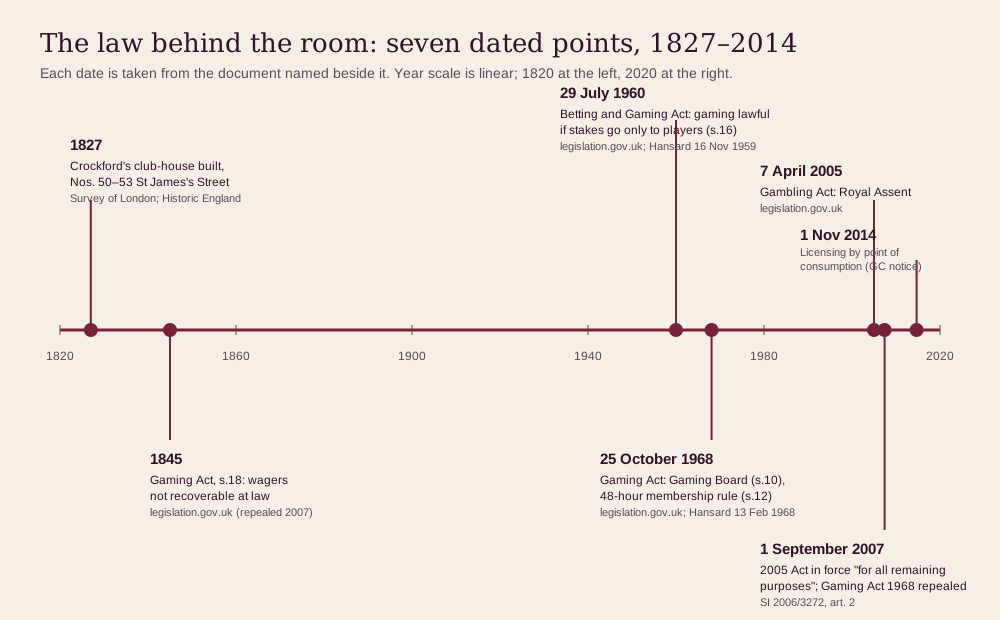
The history of casinos in England, read from the statute book
Most retellings of England's casino history borrow their dates from each other. This one takes them from the Acts, the commencement orders, Hansard and the listing records, and marks where a familiar date could not be found in any of them.
Read The history of casinos in England, read from the statute book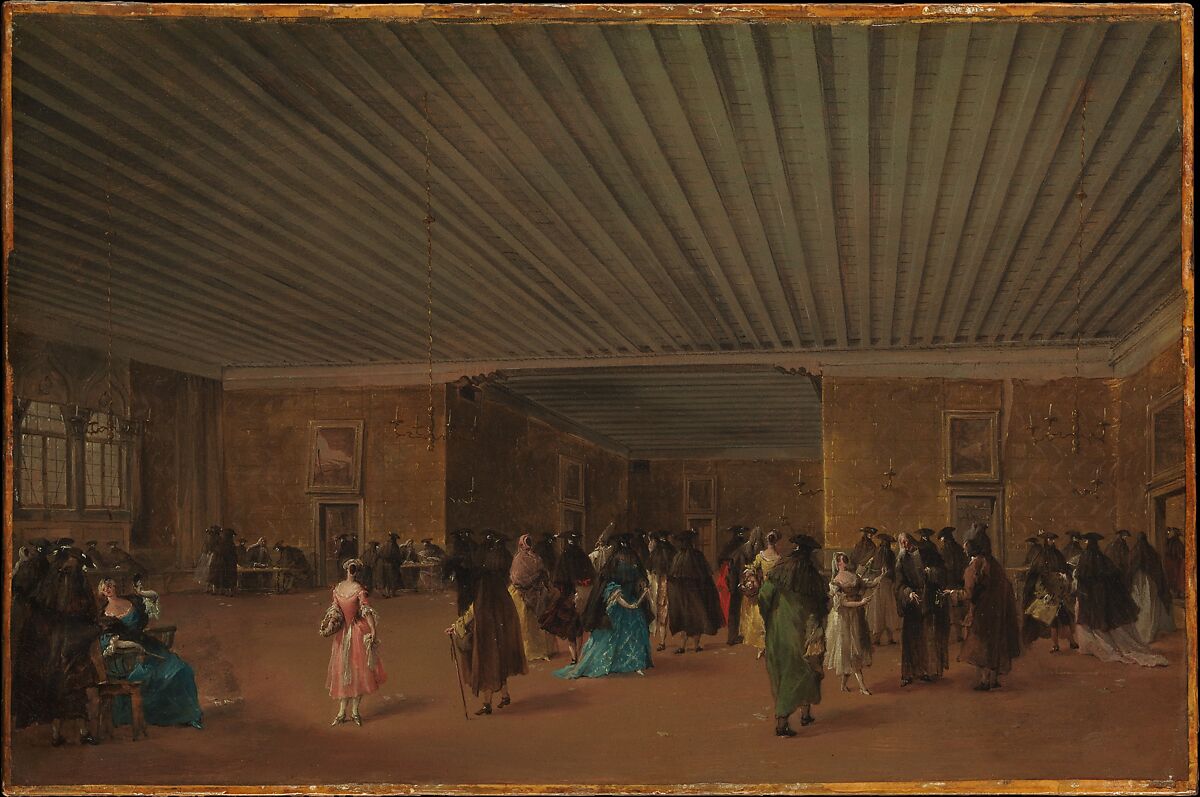
Behind the mask at Venice’s Ridotto
A state-run gaming room, a Carnival costume and two Guardi paintings reveal a Venetian institution shaped by social distinctions as much as disguise.
Read Behind the mask at Venice’s Ridotto
How the Stardust put the Space Age on the Strip
Stars, strange letterforms and an enormous roadside structure turned a resort name into a period artifact.
Read How the Stardust put the Space Age on the Strip
The Moulin Rouge sign carries a larger story
A preserved name can lead beyond nostalgia to questions about who was welcome in a city.
Read The Moulin Rouge sign carries a larger story
How did online casinos develop? A history in three records
Three dated records reveal different parts of the online casino story: the Web, the British market and the design of the screen.
Read How did online casinos develop? A history in three records
Continue reading
How the Gambling Act 2005 classified remote gambling
Read five legislative records to see how remote gambling became a category, why the Act named several media, and why 2005 and 2007 mean different things.
Read How the Gambling Act 2005 classified remote gamblingThe history of casinos in England, read from the statute book
Most retellings of England's casino history borrow their dates from each other. This one takes them from the Acts, the commencement orders, Hansard and the listing records, and marks where a familiar date could not be found in any of them.
Read The history of casinos in England, read from the statute bookHow did online casinos develop? A history in three records
Three dated records reveal different parts of the online casino story: the Web, the British market and the design of the screen.
Read How did online casinos develop? A history in three recordsBehind the mask at Venice’s Ridotto
How the Stardust put the Space Age on the Strip
The Moulin Rouge sign carries a larger story
The history of casinos in England, read from the statute book