
Casino history & culture
How the Gambling Act 2005 classified remote gambling
Read five legislative records to see how remote gambling became a category, why the Act named several media, and why 2005 and 2007 mean different things.
| Fact | Record | Source · date |
|---|---|---|
| Subject | Casino history & culture | Contents · 19 September 2026 |
| Form | Reading note · 8 parts | This spread |
| Records cited | 5 sources, with retrieval dates | Endnotes · checked 19 September 2026 |
| Operator pages | None inspected for this reading | Not applicable |
A television belongs in this online-casino history
The Gambling Act 2005 put the internet, telephone, television and radio in the same definition of remote communication. That small list is a useful corrective to a history of online casinos told entirely through websites and apps. Parliament classified a way of participating in gambling; it did not name one screen as the inevitable destination of the industry.
Read section 4 in its original, enacted version and the organising idea becomes visible. Participation through remote communication supplies the definition. The named technologies follow, together with a broader provision covering other communication technology. A list that includes radio may look unexpected beside a present-day casino lobby, but the wording is there in the original document.
This is a history of that classification, using five legislative records retrieved on 19 September 2026. It does not identify the first online casino, date the first mobile wager or reconstruct the popularity of interactive television. Those would need different archives. Its narrower question is how the Act classified participation through remote communication and separated that classification from the device being used.
Sources: Gambling Act 2005, section 4 as enacted.
Follow the paper trail back to 2001
The explanatory notes supply a compact documentary sequence: the Gambling Review Body reported in July 2001; the government published A Safe Bet for Success in March 2002; a draft Bill followed in November 2003, with further draft clauses in February and March 2004. The Act received Royal Assent on 7 April 2005. These are the dates of reports, proposals and legislation, not opening dates for gambling services.
That distinction changes how a timeline should be drawn. A report is evidence of a policy discussion. A White Paper records the government's proposals. A draft Bill exposes proposed wording to scrutiny. An Act records what passed. Lining up those objects shows a process of making a category, rather than a single moment when someone supposedly switched on British online gambling.
The notes identify the documents; this article has not independently examined every underlying report in that sequence. A reader following the trail should preserve that attribution. Writing that the notes date the review to July 2001 is supported. Claiming that every recommendation in the review became law would require a much closer comparison of the report and the enacted provisions.
A definition broad enough to survive the device
Section 4 ends its list with “any other kind of electronic or other technology for facilitating communication”. The breadth is part of the enacted text. It also gives the Secretary of State a power to specify whether a particular system or method is to count as remote communication.
The historical reading offered here is that the unit of classification was the communication relationship. Internet and telephone were examples within it. This is an interpretation of the structure of the section, not a quotation of a minister's intention. The distinction matters because a familiar retrospective story can otherwise turn into a claim that lawmakers anticipated every feature of a later app.
Imagine an archive catalogue organised only by hardware. A desktop casino screen would sit in one drawer, a television service in another and a telephone service somewhere else. A catalogue organised around section 4 would first ask how participation was communicated. The second arrangement makes connections visible that the first may conceal. Neither tells us how many people used a service or what they felt about it.
Sources: Gambling Act 2005, section 4 as enacted.
The category also appeared on the licence
Section 67 carried the distinction into operating licences. In the original Act, a remote operating licence authorised activity in respect of remote gambling or carried on through remote communication. The licence had to state whether it was remote, and a remote licence could not also authorise activity falling outside both descriptions.
This gives the archive a second object besides the definition: the permission under which an activity would operate. A photograph of a casino room and a capture of a gambling website might share a name, colours or games. That visual continuity would not, on its own, establish that the same permission covered both. The legal category asks a different question from the brand identity.
The explanatory summary describes the Act's new regulator and licensing framework for Great Britain. It also expressly discusses gambling by remote communication. For an online-casino history, the useful point is that remote activity was addressed inside the framework, rather than left to a later invention of the word app. This is not a present-day licence-checking guide; the original text is being read as a historical record.
Sources: Gambling Act 2005, section 67 as enacted; Gambling Act 2005 explanatory notes: Summary.
Build a timeline with an evidence column
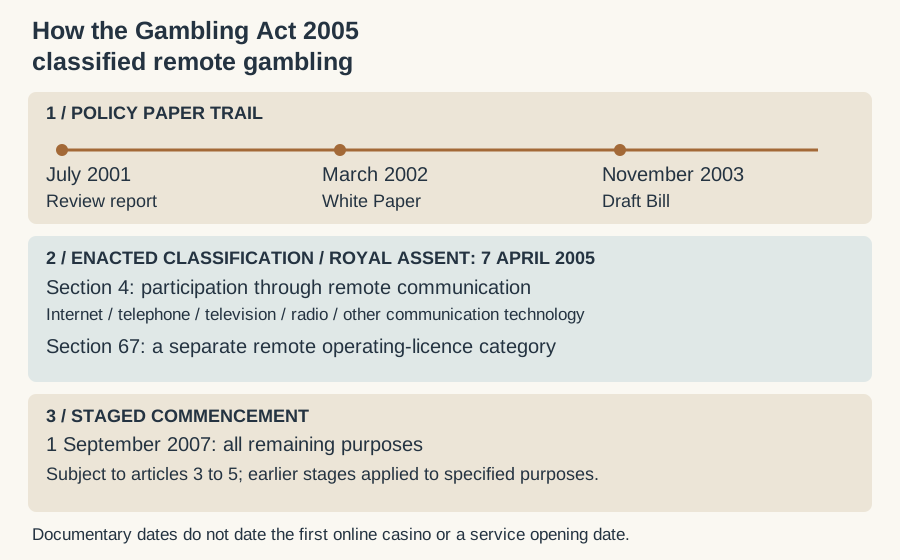
The accompanying figure separates policy documents, enacted classification and commencement. Its dates come from the explanatory background and the commencement order. The middle panel identifies sections 4 and 67 rather than implying that each acquired practical effect on the day Royal Assent was given.
Here is a worked catalogue entry for each stage. July 2001: record type, review report; evidence, the explanatory notes' retrospective description; conclusion, the review is part of the stated legislative background. March 2002: record type, White Paper; evidence, the same notes; conclusion, government proposals followed the review. November 2003: record type, draft Bill; conclusion, the proposals had reached a form intended for scrutiny.
For 7 April 2005, change the record type to enacted legislation. The appropriate annotation is that the Act received Royal Assent, with a remote definition and a separate remote operating-licence category in its text. Do not annotate the row as the first day anyone could gamble online. That claim is broader than the evidence in the row.
For 1 September 2007, use the commencement order's qualified description: the Act came into force for remaining purposes, subject to the stated exceptions. A careful timeline leaves those words visible. It does not replace a staged legal process with a more memorable but less accurate birthday.
Sources: Gambling Act 2005 explanatory notes: Background; Gambling Act 2005, section 4 as enacted; Gambling Act 2005, section 67 as enacted; The Gambling Act 2005 (Commencement No. 6 and Transitional Provisions) Order 2006, article 2.
Why 2005 and 2007 both appear in the record
Article 2 of the Gambling Act 2005 (Commencement No. 6 and Transitional Provisions) Order 2006 sets out dates of 1 January, 30 April and 1 June 2007 for specified provisions and purposes. It then gives 1 September 2007 for all remaining purposes, subject to articles 3 to 5. That is why an enactment year and an operational transition year can both belong in an account of the same legislation.
The original order is more informative than an unqualified statement that the Act began in 2007. It shows that commencement was organised through schedules and purposes. This article has not traced every schedule entry to a particular business's first licence, so the figure does not give a separate commencement date to every provision it names.
For a reader keeping historical notes, use two date fields: document date and event described. Add a third field for the source version. An enacted section and today's revised section may answer different questions. A later web retrieval date belongs in the citation, not in the historical timeline as though it were another event in the development of online casinos.
Sources: The Gambling Act 2005 (Commencement No. 6 and Transitional Provisions) Order 2006, article 2.
Try the classification on three imaginary archive items
Consider three deliberately invented catalogue items: a desktop casino's help screen, a television gambling service's instruction card and a telephone betting service's script. They are examples for reasoning, not objects this journal claims to possess. Give each a blank field for its actual date and provenance; invented examples must not acquire invented history.
For the desktop item, ask whether the record shows participation through the internet or merely advertising for a physical room. For the television item, distinguish watching a programme about gambling from using a service to participate. For the telephone script, distinguish placing a wager from calling customer support. The presence of a device does not itself answer the participation question.
Next ask what evidence would connect the item to an operator and a permission at the time. A logo alone cannot complete those fields. A help screen may describe use without identifying the contracting entity; a photograph of a licence may identify permission without documenting the service's interface. Record the gap rather than making the objects stand in for one another.
This exercise explains the value of the statutory category to cultural history. It lets a researcher relate different media while still respecting their differences. It offers no conclusion about their relative popularity, safety or commercial success. Those questions require usage records, contemporary testimony or other evidence beyond the five documents used here.
Sources: Gambling Act 2005, section 4 as enacted; Gambling Act 2005, section 67 as enacted.
Keep the screen and the statute in the same archive
An online casino leaves more than a succession of screen designs. It also leaves definitions, permissions and decisions about where regulation attaches. Reading those records alongside the screen helps explain why the history cannot be reduced to a race between devices. The internet entered a legislative vocabulary that also named older communications media.
The method is repeatable: identify the document type, choose the historical version, separate enactment from commencement, and state exactly what the record establishes. An attractive timeline becomes more useful when its uncertainty is visible. Here the firm dates concern the legislative paper trail; the missing dates concern particular services and their users. Leaving those spaces open preserves a route for further research instead of disguising an absence as a colourful origin story.
Sources: Gambling Act 2005 explanatory notes: Background; Gambling Act 2005 explanatory notes: Summary.
Written byThe editorial desk
Checked against5 dated records, 19 September 2026
MethodEditorial approach
DisclosureCommercial references
Questions answered
What did remote gambling mean in the Gambling Act 2005?
It meant gambling in which people participated through remote communication. Section 4's original list included the internet, telephone, television and radio, followed by a broader technology provision.
Did the 2005 Act only cover gambling on the internet?
No. Its remote definition named several communication methods, while the Act's broader framework also addressed non-remote gambling. The definition should not be read as an internet-only category.
Did online gambling begin when the Act received Royal Assent?
The records used here do not establish a first online-gambling date. Royal Assent on 7 April 2005 dates the legislation; it does not date the invention or first use of online casinos.
Why do histories mention both 2005 and 2007?
The Act was enacted in 2005, while the commencement order specified staged dates in 2007 and 1 September for remaining purposes, subject to exceptions. The two years describe different parts of the legislative process.