Digital culture
How did online casinos develop? A history in three records
Three dated records reveal different parts of the online casino story: the Web, the British market and the design of the screen.
The casino became an interface
An online casino has no single front door to preserve. Its entrance may be a download, a browser page, an account screen or a game opened inside another service. That makes its history unusually easy to flatten into a list of launch dates. The list looks orderly, but it can mix a company's incorporation with the release of a demonstration game, the acceptance of a first wager and the opening of a regulated service. Those are different events.
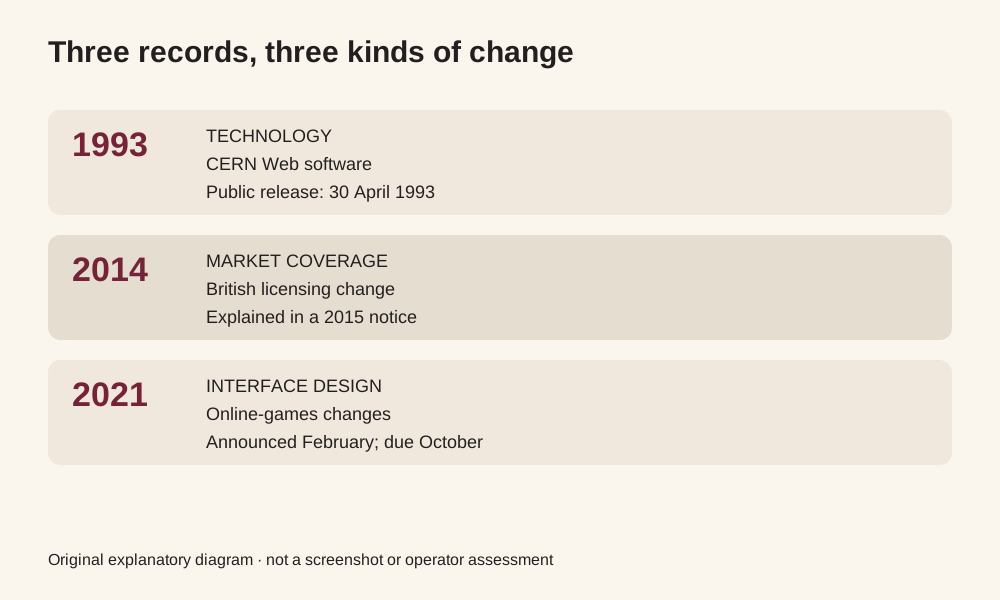
This reading follows three documented changes instead: the public release of Web software, a change to Britain's remote licensing market, and a set of rules affecting online slot interfaces. It is a deliberately selective history, not a claim to identify the world's first online casino. Each record answers one narrow question. Together they suggest how to examine the digital casino as an institution made from communications technology, commercial relationships and designed interactions.
1993: a foundation, not a casino opening
CERN dates the invention of the World Wide Web by Tim Berners-Lee to 1989 and its release of Web software into the public domain to 30 April 1993. That is strong primary evidence for a change in the availability of the technology. It is not evidence that a particular gambling business opened on that day.
The distinction matters when a history gives one dramatic date the work of several different explanations. A communications system makes certain services possible; it does not automatically establish who offered them, who could use them or under what conditions. In a casino timeline, the CERN record belongs in a technology lane. A contemporaneous operator announcement, a payment record and a licensing record would belong in other lanes. Keeping them apart produces a more useful account than placing every milestone on an undifferentiated line.
Sources: CERN: the birth of the Web.
2014: the market counted differently
A Gambling Commission statistics notice published on 25 June 2015 identifies 1 November 2014 as the introduction of the new licensing regime for operators trading with customers in Britain. It also warns that the remote figures in that particular release cover the period before the change; later editions would cover the new regime.
For a historian, that footnote is as important as a headline total. A rise between two published figures may partly reflect a change in what the regulator can see. It cannot automatically be read as a sudden rise in people's behaviour. Before drawing a growth chart, write down the reporting population, time period and geographic coverage beside each number. In this case the original notice makes the break visible. A careful history keeps it visible rather than smoothing it away.
2021: the rules entered the animation
The Commission's announcement of 2 February 2021 set a 31 October 2021 deadline for a package of online-games changes. For online slots, it described restrictions on spin speed, autoplay and features presenting returns at or below the stake as wins. The document is a dated record of a regulatory intervention in the way a game was experienced on screen.
That makes interface details historical evidence. A visible autoplay control or a celebratory animation may help a researcher frame questions about a recording's date, jurisdiction and version. It cannot, by itself, settle them. A video might show a demonstration, an overseas edition or an old capture uploaded much later. Use the announcement to identify a question for the record, not to pronounce an unfamiliar clip lawful or unlawful. Current compliance requires the current rules and the actual service context.
Sources: 2021 online-games design announcement.
The name above the game is only one identity
Our proposed archive sheet gives a separate field to the displayed brand, the company named in the terms, the software name and the source of the record. This is a research method rather than a claim that every service has the same corporate arrangement. Its purpose is to prevent a familiar logo from carrying more information than the evidence supports.
Imagine finding two screenshots with the same casino name but different account menus. They could document a redesign, a regional edition or a different moment in the business's history. Start by recording what is actually legible. Do not assign an unseen company, licence or publication date from memory. An empty field marks the next piece of research to do. In a digital collection, those unresolved identities are often the most productive part of the file.
Read a screenshot as an object with a history
A screenshot preserves an arrangement of pixels, not an entire working service. It may show which controls were visible, the words on a button and the relative size of a warning. It does not show what happened after a click, whether a game was available to a particular account, or whether a page was altered before capture. Our interpretation should stop at the boundary of the object.
Record both the capture date and the event date being discussed. Keep the original file where permission allows, note its source, and identify any cropping or redaction. For a contemporary recreation, label it as a recreation. CERN itself distinguishes the recreated first Web page from the original historical website in its account. That small act of labelling is a good model for any illustrated online-casino history.
Sources: CERN: the birth of the Web.
Try a three-date reading
The interactive record below lets you switch between the three documents used here. It separates the historical event from the date of the source and states what the source can establish. Nothing is fetched, stored or inferred about a casino account. This is a miniature archive exercise, not a live operator checker.
Notice the difference between the 2014 event and the 2015 notice explaining it. Then compare the February 2021 announcement with its October deadline. If an article uses only one date field, those distinctions can disappear. A useful note might read: announced in February; required by October; this screenshot was captured in September. That sentence is more informative than attaching 2021 to every object and assuming that they all represent the same state of the market.
Choose one source. This is a document-reading exercise, not a live casino lookup.
What a responsible timeline leaves open
The three records do not establish the first real-money online casino, the first successful withdrawal or the experience of a representative customer. No claim about those questions is made here. They would require different evidence and a definition of what counts as first. A surviving corporate claim is a starting point for investigation, not an automatic verdict.
What these documents do establish is a way of reading change without losing the source's limits. Technology enabled new forms of access; licensing changed the market visible to the British regulator; design rules addressed actions and feedback inside games. The cultural history lies in those connections. It becomes richer when the timeline shows what changed, for whom, according to which record, and which parts of the story still need an archive.
Questions answered
When did online casinos begin?
That question needs a definition of begin: a demonstration, an accepted real-money wager, a company launch or a licensed service are different events. These three records do not establish a single first online casino.
Why does 2014 matter in British online casino history?
The Gambling Commission identifies 1 November 2014 as the introduction of the licensing change for operators trading with customers in Britain. Its 2015 notice also explains the resulting change in remote-market data coverage.