
Origins
The history of casinos in England, read from the statute book
Most retellings of England's casino history borrow their dates from each other. This one takes them from the Acts, the commencement orders, Hansard and the listing records, and marks where a familiar date could not be found in any of them.
How this timeline was built
The rule for every date on this page is the same. It comes from a document that made the thing happen or recorded it at the time: the Act on legislation.gov.uk, the commencement order, the Hansard column, the Historic England list entry, the venue's own published history. Where a date circulates widely but could not be found in a document of that kind, the page says so rather than repeating it.
That rule costs something. Two dates most histories treat as settled, the day the 1960 Act took effect and the year the Clermont Club opened, are left open here. A timeline that can be checked line by line is worth more than one that is complete and unverifiable.
Scope: England, with Great Britain where the statute applies to Great Britain. Northern Ireland has its own framework and is not covered. "Casino" is used as the ordinary word; the statutes before 2005 do not use it.
1827 to 1845: Crockford's and the law that would not enforce a bet
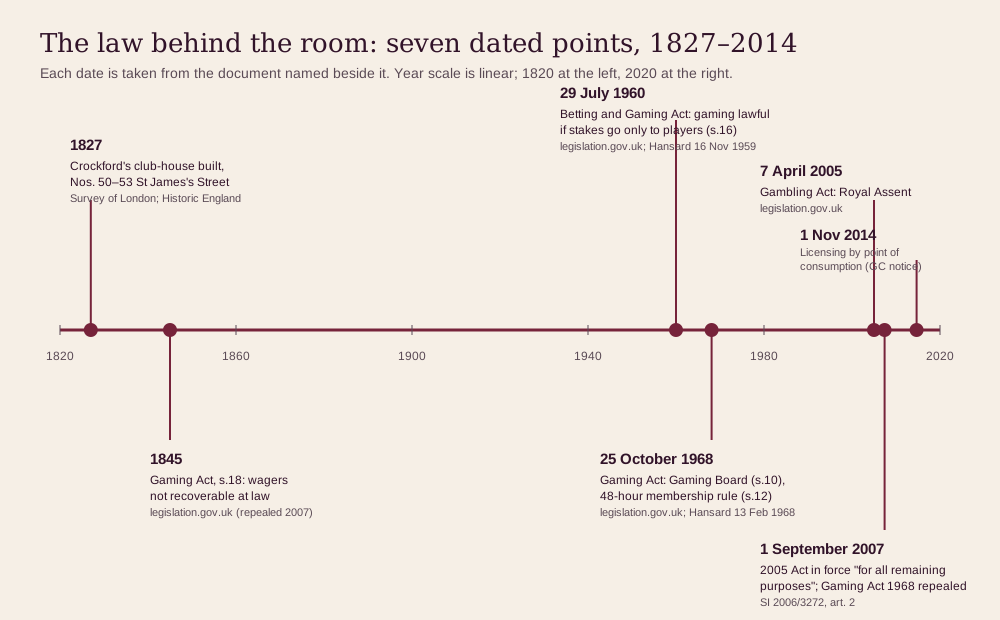
The building that anchors any history of casinos in England is not, in law, a casino at all. Historic England lists 50 St James's Street as the Devonshire Club, Grade II, first listed on 5 February 1970, and describes it as a gentlemen's club "designed in 1827 by Benjamin D. Wyatt and Philip Wyatt", adding the two words that matter: "Originally Crockford's". The Survey of London gives the same date and architect in a footnote: "Crockford's club-house at Nos. 50–53 St. James's Street had been erected in 1827 to the designs of Benjamin Dean Wyatt."
Britannica, a secondary source but a careful one, adds the man. William Crockford was born in London in 1775; "he built in 1827 a luxuriously decorated gambling house at 50 St. James's Street"; he retired in 1840 and died on 24 May 1844. Britannica does not give a closing date for the club, and neither does the list entry, which moves straight to the alterations of 1870 to 1875 by C. J. Phipps. The often quoted closure date of 1845 or 1846 is therefore not carried on this timeline.
What was the legal position of a house like Crockford's? The Acts answer that better than the memoirs. The Gaming Act 1845 (8 & 9 Vict. c. 109) carries at section 18 the heading "Wagers not recoverable at Law". legislation.gov.uk shows the heading and the repeal date, 1 September 2007, but withholds the repealed text, so the section's wording is not quoted here. Its effect, that a gambling debt could not be sued for, is not in dispute. Crockford's operated in a world where the law did not prohibit the game so much as refuse to recognise it.
Sources: Historic England: Devonshire Club, list entry 1235890; Survey of London, vols 29–30: St James's Street, east side; Britannica: William Crockford; Gaming Act 1845, section 18.
1960: the Betting and Gaming Act and the condition it set
When did casinos become legal in the UK? The honest answer has two dates, and the first is 29 July 1960, the Royal Assent of the Betting and Gaming Act 1960 (8 & 9 Eliz. 2 c. 60). Its long title is worth quoting in full because it shows how modest the intention was: "An Act to amend the law with respect to betting and gaming and to make certain other amendments with view to securing consistency and uniformity in, and facilitating the consolidation of, the said law and the law with respect to lotteries; and for purposes connected with the matters aforesaid."
The Bill's second reading in the Commons was on 16 November 1959, moved by R. A. Butler as Home Secretary. His account of the existing law is the clearest statement of why change came: "The law on gaming is complex and confusing" and "anyone who habitually keeps or uses a place for the purpose of playing games ... runs a great risk of committing a penal offence" (col. 817). On the principle the Bill adopted for gaming, he was precise: "The money staked by the players during the course of gaming must all be paid to the winner, that is, that there must be no 'cut' on the stakes for the organiser" (col. 819).
That principle became section 16 of the Act, headed "General provisions as to gaming", in Part II, "Gaming". Gaming was lawful "if, but only if" three conditions were met: that "the chances in the game are equally favourable to all the players" or the gaming was conducted so that they were; that no stakes, losses or token purchases were "disposed of otherwise than by payment to a player as winnings"; and that "no other payment in money or money's worth is required for a person to take part in the gaming". A house edge was unlawful. A bank held by the house was unlawful. A charge for entry was unlawful.
On commencement the Act is silent about a date. Section 31(3) says only: "This Act shall come into force on the appointed day." Section 28 defines that day as "such day as the Secretary of State may by order made by statutory instrument appoint", with different days permitted for England and Scotland and for different purposes. The date almost every history gives, 1 January 1961, is not in the Act. It would be in a commencement order which is not on legislation.gov.uk and which this page could not retrieve. It is recorded on the timeline below as unverified, not as fact.
Sources: Betting and Gaming Act 1960, as enacted (PDF); Hansard, Commons, 16 November 1959: Betting and Gaming Bill; Hansard: Betting and Gaming Act 1960, Royal Assent.
1968: the Gaming Act, the Gaming Board and 48 hours
The second date is 25 October 1968, Royal Assent of the Gaming Act 1968 (c. 65), an Act whose long title is one line: "An Act to make further provision with respect to gaming; and for purposes connected therewith." The distance between that line and the debate that produced it is the whole story of the 1960s.
James Callaghan, moving the second reading on 13 February 1968, said of the 1960 Act that it "was a thoroughly well-intentioned Measure and the authors must be astonished to find that the consequences of their actions are so different from their intentions." The mechanism was the club: "Almost any individual can gather together a group of people, claim to have formed a club, and then proceed to exploit commercial gaming on charge." And the result: "So-called clubs have sprung up wholesale in every part of the country. And because the law never envisaged this development, no proper safeguards exist to control these clubs."
The scale was given in the Commons the following year. On 18 November 1969 Elystan Morgan, Joint Under-Secretary at the Home Office, told the House: "When the 1968 Act was passed, we had no fewer than 1,200 gaming licences compared with 150 casino licences in France and 50 gaming clubs" (col. 1271). In the same debate Mark Carlisle noted that "only 702 applications were ever made for certificates of consent" under the new regime, and that of those "only 295 of the 702 are within the areas which are now open to consideration", the 31 permitted areas in England (col. 1267). Those three numbers describe the contraction the 1968 Act was built to produce.
Two provisions did the work. Section 10 established the regulator: "There shall be established a Board to be known as the Gaming Board for Great Britain", whose duty was "to keep under review the extent and character of gaming in Great Britain and, in particular, to keep under review the extent, character and location of gaming facilities". Callaghan had called it "the pivot of the whole system" and expected it to consist of three members, "about 20 to 25" staff and "about 15 inspectors" (cols 1174–1175). Section 12 set the membership condition that defined the British casino for the next four decades: a person could take part in gaming on licensed premises only if he had applied for membership "in writing made by him in person on the premises in question, and at that time at least forty-eight hours have elapsed since he applied".
Commencement was again by order. Section 54 brought sections 10, 43(1), 48, 51, 52 and 54 and Schedule 1 into force on passing, so the Board could be constituted, and left the rest to the Secretary of State. The date Part II licensing actually bit is given in Hansard rather than in an order this page could fetch: Morgan told the House on 18 November 1969 that nothing in the regulations could affect a club's operation "until 1st July, 1970, when the substantive provisions of the Act come into operation" (col. 1269). That is a ministerial statement of intent made eight months in advance, and it is recorded here as such.
Sources: Gaming Act 1968, introduction; Gaming Act 1968, section 10; Gaming Act 1968, section 12; Gaming Act 1968, section 54; Hansard, Commons, 13 February 1968: Gaming Bill; Hansard, Commons, 18 November 1969: Gaming Clubs (Licensing).
The venues strand: Berkeley Square and Leicester Square
The law describes rooms in the abstract. The venues strand of this journal, which gathers the essays on the Grand Lisboa, Baden-Baden, the Casino de Monte-Carlo, the Bellagio's ceiling and two casino floor plans, describes particular ones. Two English rooms belong here because their dates can be documented.
44 Berkeley Square is Grade I, first listed on 24 February 1958, and is described by Historic England as a "Town house 1742-44 by William Kent for Lady Isabella Finch". The entry records restoration work in 1963 by John Fowler and Philip Jebb. It does not mention the Clermont Club. That the club opened there under John Aspinall, and the year it did so, is repeated in every account of 1960s Mayfair, but this page found no primary document giving the opening date, and the Clermont therefore appears on the timeline only through the 1963 restoration that the listing record does carry. The gap is a real one: the most famous casino of the 1960s club era has, in the public record this page could reach, no birth certificate.
The Hippodrome on Cranbourn Street is better served, because the operator publishes its own history. "Opened in 1900 by the renowned theatre architect Frank Matcham as a circus variety theatre, the Hippodrome featured a 100,000 gallon tank in which polar bears and sea lions would swim." Works in 1909 enlarged the stage; "from 1912" the house turned to revue; "in the 1950s the Hippodrome was transformed into the legendary Talk of the Town". The casino came late: the Thomas family renovated the site "to open on July 13th 2012" what the page calls the UK's largest casino. That superlative is the venue's own claim and is not tested here. The dates are the venue's too, and are used as a venue's account of itself rather than as an independent record.
Read together, the two buildings frame the English casino as a thing that happens inside an older room. The licence arrived long after the architecture, which is why the venues strand treats floor plans and ceilings as historical evidence in their own right.
Sources: Historic England: 44 Berkeley Square, list entry 1066466; Hippodrome Casino: The History of The Hippodrome.
2005 to 2007: the Gambling Act and the Commission
The Gambling Act 2005 (c. 19) received Royal Assent on 7 April 2005. Its long title is shorter still than 1968's: "An Act to make provision about gambling." The explanatory notes, prepared by the Department for Culture, Media and Sport, trace it to the Gambling Review Body's report of July 2001 and the White Paper "A Safe Bet for Success" of March 2002, and describe the Act as establishing "a new regulatory system to govern the provision of all gambling in Great Britain, other than the National Lottery and spread betting".
Three things in the Act define the modern period. First, section 1 states the licensing objectives, quoted here in the statute's order: "preventing gambling from being a source of crime or disorder, being associated with crime or disorder or being used to support crime"; "ensuring that gambling is conducted in a fair and open way"; "protecting children and other vulnerable persons from being harmed or exploited by gambling". Second, the notes at paragraph 8 describe "a unified regulator for gambling in Great Britain, the Gambling Commission", taking on functions previously exercised by licensing justices. Third, section 4 defines the category the 1968 Act never imagined: "'remote gambling' means gambling in which persons participate by the use of remote communication", with the internet, telephone, television and radio listed as examples. The notes at paragraph 15 explain the point: regulation "of gambling where the player is not present on the operator's premises".
For casinos specifically, the notes at paragraph 17 describe three categories, regional, large and small, and at paragraph 18 an initial cap of "1 regional casino, and 8 small and 8 large casinos", with existing 1968 Act casinos allowed to continue. The regional casino was never built; that outcome belongs to the record of change and is not pursued here.
Commencement followed the pattern of 1960 and 1968. Section 358 provides that "the preceding provisions of this Act shall come into force in accordance with provision made by the Secretary of State by order", with power to bring Part 2 in early for the purpose of setting up the Commission. The order that finished the job is the Gambling Act 2005 (Commencement No. 6 and Transitional Provisions) Order 2006, SI 2006/3272. Article 2 brings scheduled provisions into force on 1 January 2007, 30 April 2007 and 1 June 2007, and then: on 1 September 2007 "the 2005 Act shall come into force for all remaining purposes". legislation.gov.uk records that same date, 1 September 2007, as the repeal date of the Gaming Act 1845; the Gaming Act 1968 went with it.
The Commission's own account of the transition is brief. On its appraisal-methodology page it states that it replaced the Gaming Board for Great Britain, which "ceased to exist in 2007 following a transition period to the Commission", and that there are "no inherited records from the Gaming Board". A 2023 freedom of information response repeats the point: "when the Commission took over from the Gaming Board in 2007 there were no electronic files transferred", and the Board's surviving paper records "were destroyed in 2020 as part of our records management deletion process". The regulator that licensed every British casino from 1970 to 2007 has, by its successor's account, left no files in its successor's hands.
Sources: Gambling Act 2005, introduction; Gambling Act 2005, section 1; Gambling Act 2005, section 4; Gambling Act 2005, section 358; Gambling Act 2005 explanatory notes: background; Gambling Act 2005 explanatory notes: summary; SI 2006/3272, article 2; Gambling Commission: history of the Commission (appraisal methodology); Gambling Commission: FOI response on Gaming Board records.
2014: licensing by where the player is
The last date on the timeline is the one that turned the online casino into a British one. The Gambling (Licensing and Advertising) Act 2014 (c. 17) received Royal Assent on 14 May 2014; its long title reads "An Act to make provision about the licensing and advertising of gambling." The Gambling Commission's statistics notice of 25 June 2015 gives the operative date: "Following introduction of the Gambling (Licensing and Advertising) Act on 1 November 2014, all operators trading with customers in Britain must be licensed by the Commission".
The shift is from the operator's premises to the customer's location, and it closes the arc that began with section 16 of the 1960 Act. In 1960 the law asked where the game was played and whether the house took a cut. In 2014 it asked where the player was. The present-day consequences of that, which jurisdictions' licences count and what each one requires, are the territory of the regulatory geography of online casinos and are not repeated here; what changed after 2014, and when, is charted at the record of UK online casino regulation over time. This page stops where the past does. Our own shorter piece on how online casinos developed, in three dated records reads the 2014 change alongside the 1993 release of Web software and the 2021 slot-design rules.
Sources: Gambling (Licensing and Advertising) Act 2014, introduction; Gambling Commission: industry statistics notice, 25 June 2015.
The timeline as a table
Each row names the document the date was taken from and states what that document establishes. The "establishes" column is the point of the exercise: a Royal Assent date does not tell you when a law bit, and a listing record does not tell you when a club opened. Rows marked unverified carry a date that is widely repeated but that this page could not find in a primary document; they are included so the gap is visible, not so the date is relied on.
| Date | Event | Document | What the document establishes, and what it does not |
|---|---|---|---|
| 1638 | Marco Dandolo permitted to open public gaming rooms at Palazzo Dandolo, Venice (the Ridotto) | Metropolitan Museum of Art, catalogue entry for Guardi's Ridotto Pubblico | Museum's account of the licence; also records the 1768 remodelling and the 1774 closure by the Grand Council. Not an English event; included because the "oldest casino" question runs through it. |
| 1742–44 | 44 Berkeley Square built by William Kent for Lady Isabella Finch | Historic England list entry 1066466 | Building date and architect. Says nothing about the Clermont Club. |
| 1827 | Crockford's club-house built, Nos. 50–53 St James's Street, to designs of Benjamin Dean Wyatt (and Philip Wyatt per Historic England) | Survey of London vols 29–30; Historic England list entry 1235890 | Building date and architects; "Originally Crockford's". Neither gives an opening or closing date for the club. |
| 1845 | Gaming Act 1845, section 18: "Wagers not recoverable at Law" | legislation.gov.uk, 8 & 9 Vict. c. 109 | Section heading and repeal date (1 September 2007). Text of the repealed section not displayed. |
| 16 November 1959 | Second reading of the Betting and Gaming Bill, Commons; R. A. Butler | Hansard, cols 810–819 | Purpose of the Bill and the "no cut on the stakes" principle. A debate, not the law. |
| 29 July 1960 | Royal Assent, Betting and Gaming Act 1960 (c. 60) | legislation.gov.uk PDF; Hansard Act record | Date the Act became law; section 16 conditions; section 31(3) "come into force on the appointed day". |
| 1 January 1961 (unverified) | Commonly given commencement of the 1960 Act's gaming provisions | None retrieved | Not in the Act. Depends on a commencement order under section 28 that this page could not fetch. |
| 28 February 1963 | Royal Assent, Betting, Gaming and Lotteries Act 1963 (c. 2), a consolidation | legislation.gov.uk | Consolidated the 1960 Act with earlier law; did not change the gaming principle. |
| 1962 (unverified) | Clermont Club opens at 44 Berkeley Square under John Aspinall | None retrieved | Universally repeated; no primary document found. The listing records 1963 restoration by Fowler and Jebb. |
| 13 February 1968 | Second reading of the Gaming Bill, Commons; James Callaghan | Hansard, cols 1174–1175 for the Board | Government's diagnosis of the 1960 Act and design of the Gaming Board. A debate, not the law. |
| 25 October 1968 | Royal Assent, Gaming Act 1968 (c. 65) | legislation.gov.uk; Hansard Act record | Sections 10 (Gaming Board), 12 (48-hour rule), 54 (partial commencement on passing). |
| 18 November 1969 | Home Office states 1,200 gaming licences existed when the 1968 Act passed; 702 applications for consent; 295 within permitted areas | Hansard, cols 1267–1271 | Figures as given to the House; not audited here. |
| 1 July 1970 | Substantive provisions of the 1968 Act to come into operation | Hansard, 18 November 1969, col. 1269 | A minister's forward statement. The commencement order itself was not retrieved. |
| 1900; 13 July 2012 | Hippodrome opens as a Matcham circus theatre; reopens as a casino | Hippodrome Casino, "The History of The Hippodrome" | The venue's own account. "UK's largest casino" is its claim, not tested. |
| July 2001; March 2002 | Gambling Review Body report; White Paper "A Safe Bet for Success" | Explanatory notes to the 2005 Act, paras 3–4 | Dates as given in the notes; the documents themselves were not fetched. |
| 7 April 2005 | Royal Assent, Gambling Act 2005 (c. 19) | legislation.gov.uk | Section 1 objectives, section 4 remote gambling, section 358 commencement by order. |
| 1 January, 30 April, 1 June 2007 | Staged commencement of scheduled provisions | SI 2006/3272, article 2 | Which provisions is in the Order's schedules, not summarised here. |
| 1 September 2007 | 2005 Act "in force for all remaining purposes"; Gaming Act 1845 and Gaming Act 1968 repealed; Gaming Board ceases | SI 2006/3272, art. 2; legislation.gov.uk repeal note; Gambling Commission history page | Commencement date is exact. The Commission's page gives the Board's end as "2007" without a day. |
| 14 May 2014 | Royal Assent, Gambling (Licensing and Advertising) Act 2014 (c. 17) | legislation.gov.uk | Date the Act became law. |
| 1 November 2014 | All operators trading with customers in Britain must hold a Commission licence | Gambling Commission statistics notice, 25 June 2015 | The regulator's statement of the operative date, published seven months after it. |
The method is repeatable. Take any date from any history of casinos in England, find the Act, order or record that would have created it, and see whether the date is there. Where it is not, the row says "unverified", and a reader who finds the missing order is invited to write in.
The older questions: Venice, the word, the first game
Four older questions travel with this subject, none of them English. They are answered here from a document each, with the same willingness to leave a thing open.
Who created the first casino depends on what counts. The Metropolitan Museum of Art's catalogue entry for Guardi's painting records that in 1638 "permission of the Venetian republic was accorded to Marco Dandolo to open public assembly and gaming rooms", licensed, in the museum's words, "to control and derive profit from what had been a widespread and illicit private activity". A state licence, a named proprietor, a public room: that is the earliest such combination this page can document. Our essay on the Ridotto and its masks reads the same institution through the museum's records. It does not make the Ridotto the first place people gambled, and no document could.
The oldest casino in the world is a claim rather than a fact. The Met records that the Grand Council "shut the place down permanently in 1774". A present-day Venetian casino tracing its descent from 1638 is asserting continuity across a closure of that kind, and continuity of that sort has to be shown, not inherited from the name. For Britain the question is easier to dispose of. Licensed casinos could not exist before the 1968 Act's Part II took effect, so no English casino can be older, as a licensed casino, than 1970. Crockford's building of 1827 is the oldest building in England erected for the purpose; the club inside it closed within Crockford's lifetime or shortly after, and the room that now trades under his name elsewhere is a different institution.
Where the word comes from is the one question with a clean answer. Etymonline gives Italian casino, "a little house", diminutive of casa, from Latin casa, "hut, cottage, cabin"; attested in English in 1744 as "public room for music or dancing", and in 1820 as "building for aristocratic gambling", first in an Italian context. The 1820 witness it quotes is Jane Waldie Watts, complaining that the term was "indiscriminately applied to a set of farm offices, a country-seat, a gambling house, and a game of cards". The card game, cassino, is attested under that name in 1792. Etymonline is a secondary dictionary; the Oxford English Dictionary entry was not consulted.
What the oldest casino game is has no documentary answer this page can give. A game's age and a casino's age are different questions, and the documents fetched for this timeline, statutes, listings and a museum catalogue, do not date games. The 1792 attestation of "cassino" as a card game is the oldest game-related date on this page, and it is a date for a name, not for a game. The question is left open in the FAQ below rather than answered with a guess.
Sources: The Metropolitan Museum of Art: Guardi, The Ridotto Pubblico at Palazzo Dandolo; Etymonline: casino.
Archive sources
- Betting and Gaming Act 1960, as enacted (PDF), legislation.gov.uk, retrieved 18 September 2026.
- Betting and Gaming Act 1960, contents, legislation.gov.uk, retrieved 18 September 2026.
- Gaming Act 1968, introduction, legislation.gov.uk, retrieved 18 September 2026.
- Gaming Act 1968, section 10: Gaming Board for Great Britain, legislation.gov.uk, retrieved 18 September 2026.
- Gaming Act 1968, section 11, legislation.gov.uk, retrieved 18 September 2026.
- Gaming Act 1968, section 12: who may participate in gaming, legislation.gov.uk, retrieved 18 September 2026.
- Gaming Act 1968, section 54: short title, commencement and extent, legislation.gov.uk, retrieved 18 September 2026.
- Gambling Act 2005, introduction, legislation.gov.uk, retrieved 18 September 2026.
- Gambling Act 2005, section 1: the licensing objectives, legislation.gov.uk, retrieved 18 September 2026.
- Gambling Act 2005, section 4: remote gambling, legislation.gov.uk, retrieved 18 September 2026.
- Gambling Act 2005, section 358: commencement, legislation.gov.uk, retrieved 18 September 2026.
- Gambling Act 2005, explanatory notes: introduction, legislation.gov.uk, retrieved 18 September 2026.
- Gambling Act 2005, explanatory notes: background, legislation.gov.uk, retrieved 18 September 2026.
- Gambling Act 2005, explanatory notes: summary, legislation.gov.uk, retrieved 18 September 2026.
- The Gambling Act 2005 (Commencement No. 6 and Transitional Provisions) Order 2006, article 2, legislation.gov.uk, retrieved 18 September 2026.
- Gaming Act 1845, section 18, legislation.gov.uk, retrieved 18 September 2026.
- Betting, Gaming and Lotteries Act 1963, introduction, legislation.gov.uk, retrieved 18 September 2026.
- Gambling (Licensing and Advertising) Act 2014, introduction, legislation.gov.uk, retrieved 18 September 2026.
- Betting and Gaming Bill, second reading, 16 November 1959, Hansard (UK Parliament), retrieved 18 September 2026.
- Betting and Gaming Act 1960: parliamentary record, Hansard (UK Parliament), retrieved 18 September 2026.
- Gaming Bill, second reading, 13 February 1968, Hansard (UK Parliament), retrieved 18 September 2026.
- Gaming Act 1968: parliamentary record, Hansard (UK Parliament), retrieved 18 September 2026.
- Gaming Clubs (Licensing), 18 November 1969, Hansard (UK Parliament), retrieved 18 September 2026.
- History of the Gambling Commission (appraisal methodology and selection policy), Gambling Commission, retrieved 18 September 2026.
- Gaming Board's Annual Advice to Licensing Authorities (FOI response), Gambling Commission, retrieved 18 September 2026.
- Who we are, Gambling Commission, retrieved 18 September 2026.
- Latest gambling industry statistics published, April 2010 to September 2014, Gambling Commission, retrieved 18 September 2026.
- Devonshire Club, 50 St James's Street: list entry 1235890, Historic England, retrieved 18 September 2026.
- 44 Berkeley Square: list entry 1066466, Historic England, retrieved 18 September 2026.
- Survey of London, volumes 29–30: St James's Street, east side, British History Online, retrieved 18 September 2026.
- William Crockford, Encyclopaedia Britannica, retrieved 18 September 2026.
- The History of The Hippodrome, Hippodrome Casino, retrieved 18 September 2026.
- Francesco Guardi, The Ridotto Pubblico at Palazzo Dandolo, The Metropolitan Museum of Art, retrieved 18 September 2026.
- casino, Online Etymology Dictionary, retrieved 18 September 2026.